Planting Trees As Penance For Sin?

"I guess I would ask which human beings - where and when - are to be accorded the privilege of deciding that this particular climate we have today is the best climate for all other human beings. I think that's a rather arrogant position for people to take." Michael Griffin NASA Administrator.

Robert Royal in First Things examines the position of various religious leaders on the current discussion surrounding global warming. Paraphrasing what he writes we read:

Religious fervor for curbing global warming and protecting the environment reached a confusing peak this week when a member of the Council for Culture at the Vatican announced that offsetting carbon emissions, which the Holy See will be able to do almost completely in the future thanks to a donation of land in Hungary to be planted with trees, is roughly parallel to doing penance for your sins. There’s nothing wrong and a good deal right with contemporary religious leaders pointing out our responsibilities to care for the Earth. But with all due respect to the good monsignor, it’s a very bad idea to suggest that steps to deal with environmental questions are like doing penance for sins.

Carbon emissions are not intrinsically wrong. All animals that inhale oxygen and exhale carbon dioxide do so by natural design all the time. Even cars, electricity generating plants, and mechanical appliances do much good in addition to adding to atmospheric greenhouse gases. Deciding when and how to use them is not like deciding to cheat on your wife, an intrinsic wrong that requires confession and penance. It’s more like deciding how much of the family income to allot for a better gas-mileage car, and how much for food, housing, healthcare, or education for the children. In other words, it’s always a choice among competing goods, not between good and evil, within limited resources.

In addition, though the potential negative consequences of global warming are worthy of serious consideration, they need to be put in the proper perspective of the actual nature of the world that God created. Temperatures on the earth have changed drastically without benefit of human intervention. In the multiple Ice Ages that have regularly occurred over geological time, glaciers miles thick covered Northern Europe and much of North America. At their retreat, they scraped the earth cleaner than any logging company would dare, but enabled the growth of the lovely boreal forests we prize today.

In historical times, the changes have been less drastic but still quite striking. Leif Eriksson found grapes growing in Newfoundland, which is why he called it Vineland. Other explorers seem to have had similar reasons for giving the frozen expanses of today’s Greenland its name. From just before 1000 A.D. and continuing for a few centuries, the earth experienced what is sometimes called a Medieval Climate Optimum, a period of significant warming that may have helped in the cultural recovery of Europe, followed by a cooler period called the Little Ice Age beginning in the sixteenth century and lasting until around 1850. Since then, the earth has generally warmed but with another cooling dip from around 1950 to 1975. These simple facts of geology are much cited by both sides in the debates about global warming. But it’s rare to find any religious figure who shows any familiarity with the fact that God did not create a world of stable climate where species and habitats are forever fixed and or that change represents anything other than a violation of, and perhaps a sin against, the created order.

NASA administrator Michael Griffin was vilified when he called it “rather arrogant” to assume that the present climate was optimal for human beings. Contrary to the claims of his critics, Griffin was not saying that global warming should not be examined carefully. What he was saying - that we need to calm down and examine evidence more fully - is so outside the generalized hysteria among the media and the political class that his opponents could not fathom it. A similar fate has befallen Bjorn Lomborg, whose just-released book Cool It looks to be a worthy sequel to his controversial The Skeptical Environmentalist. This statistician has tried to weigh the various potential harms and benefits of global warming, which he not only believes is occurring but concedes is significantly owing to anthropogenic causes. There are two unforgivable sins among the most fervid environmentalists. As Al Gore has taught us, one is being a global-warming denier, which is on a moral level with the Holocaust deniers. Deniers at least can be summarily excommunicated. But it is precisely the Lomborgs and his like who are more infuriating to a certain type of true believer. To acknowledge anthropogenic global warming and to believe it may be effectively handled through anything but curtailing global capitalism through reducing carbon emissions, or, even worse, that we ought to add some of global warming’s benefits to our deliberations seems, to some, on a par with calling evil good.

But the facts are the facts. In Cool It, for example, Lomborg analyzes the conditions that produced the thirty-five thousand deaths in Europe during the infamous and much reported on heat wave of August 2003. That was a great tragedy, but every year, in Europe and around the world, far more people die of cold. In August 2003, some two thousand Britons died from the heat; on average, twenty-five thousand Britons a year die of cold and in some years more than twice that figure. If you turn to any ordinary media outlet, you will hear the usual litany of impending catastrophes: twenty-foot sea rises owing to Greenland melting that will submerge Florida and Bangladesh; widespread famine and death because of changes in precipitation patterns; the spread of tropical diseases to warmer environments; and of course the disappearance of charismatic flora and fauna. This, we are told, is the scientific consensus that should tug at our heart strings, and only reduced carbon emissions can prevent such an apocalypse.

This is a mixture of truth and misapprehension. If the Greenland ice pack melts, for example, it will take one thousand years and over the next century will produce a sea-level rise of about one foot. Furthermore, it is not at all clear that this Greenland, which was naturally green around 1000 A.D., is being ravaged by human activity. Glaciation naturally varies a great deal in the Northern Hemisphere and similar doomsday scenarios were common in the 1930s, a naturally occurring warm period that preceded emissions of large quantities of greenhouse gases.

Our religious leaders cannot be expected to be experts in environmental sciences or policies. But it would be a great help toward a better climate debate if they made greater allowance for the complexities of creation and the inevitable trade-offs in policy decisions while calling us all to responsible action. Our technological developments have brought great benefits to the whole of humanity in the past century. Failure to spread those benefits further may be the greatest harm we can do to the poor and marginalized. And it is beyond question a mistaken application of a crucial religious notion to suggest that the costs of those benefits are, even metaphorically, like sins.


Robert Royal is president of the Faith & Reason Institute in Washington, D.C., and author of The Virgin and the Dynamo: Use and Abuse of Religion in Environmental Debates

Global Warming - Curse or Blessing?

Posted September 26, 2007

Proverbs As The Motif In '3:10 To Yuma'?

"You're so sure that your crew's comin' to get you?" - Dan Evans
"Sure as God's vengeance, they're comin" - Ben Wade


"All a man's ways seem right to him, but the Lord weighs the heart" - Ben Wade quoting Proverbs 21:2.

Christianity Today recently reviewed the religious and moral aspects of James Mangold's new movie '3:10 to Yuma'. The review states in part:

'3:10 To Yuma' is a very modern western. This is a film that strives for and achieves a deeper inquiry into moral psychology. On one level it's about gunfights, spurs, and saloon showdowns, but on another it's a film about the fuzzy lines between right, wrong, and the law in an altogether lawless frontier land.

Director James Mangold deals with the personal quest for honor and redemption. Dan Evans is down on his luck, about to lose his ranch to the Southern Pacific suits who are bringing the railroad to the tiny town of Bisbee. Seeking to redeem himself financially and in the eyes of his adolescent son Will Evans stumbles upon a major chance to prove himself. The notorious outlaw, Ben Wade has just been captured. Hoping to rid the region once and for all of this infamous scourge to the railroad's safety, a Southern Pacific businessman offers to handsomely reward any man who will join the posse to safely transport Wade to prison. Evans jumps at the opportunity, but the task is easier said than done. It's a three-day journey to the town of Contention, where Wade is to be put on the 3:10 train to the Federal Court in Yuma. And it promises to be a perilous journey fraught with hostile Indians, railroad ruffians, as well as the violent gang of outlaws determined to free their leader, Wade, before he is put on the train to Yuma.

As the fateful journey plays out, bullets fly and blood is spilt. The posse finds Wade to be deadly even when bound and gun-less. As the body count grows Evans becomes determined to be the last man standing with Wade—the man who successfully delivers the criminal to the law in Yuma.

Wade seems to respect Evans as a morally upright family man driven only by a desire to protect his land and dignity. Likewise, Evans seems uninterested in destroying Wade. If not for the circumstances of their meeting, they might have been friends. Ben Wade is a self-described rotten-to-the-core villain who is as enchanted with his own mythology as everyone else is fearful of it. He is a holster-bearing Hannibal Lecter—minus the cannibalism. Like Lecter, Wade works on his victims primarily psychologically. He's deadly with his gun ("the hand of God"), but his words are even deadlier.

Like many of cinema's most psychologically toxic antagonists, Wade is well read and adroit at quoting Bible verses to tease his foes. Apparently he read the Bible cover to cover only once but he quotes it like a preacher. His motto seems to be Proverbs 21:2: "All a man's ways seem right to him, but the Lord weighs the heart." Wade takes from this verse a twisted justification for his own wayward actions—apparently believing that since God is ultimately the only judge of right and wrong, man has no mandate but to do what is right in his own eyes.

Wade's odd brand of moral relativism makes him an interesting character—especially in the film's final moments, when his mythologized shell begins to crack. Evans' motivations become more ambiguous as the film goes on. Is it really about the reward money or serving justice? Or is it a pride issue? Some deeper psychological drive that makes him in the end not all that different from Wade? As he is forced to kill dozens of people and put his own family in grave danger, these questions become ever more pertinent. At what point does proving your honor become secondary to protecting yourself and the lives of your loved ones?

Much of the tension of the film comes from what we know is coming at 3:10. As the train's arrival becomes imminent, so too does the dread of an unavoidably nasty fight. Wade's gang catches up to Evans's posse in Contention and their second-in-command leader, Charlie Prince, unleashes a ruthless wrath. Prince, who is really the worst scoundrel in the bunch is a deliciously wicked character who steals most of the scenes he's in. Foster really captures the soulless, unruly spirit of the western outlaw.

Yuma portrays a West that is stark, barren, and morally ambiguous … very few characters are all good or all bad … everyone is a mixture (just as Evans and Wade are, in a way, two sides of the same coin) and everyone has an opportunity to change, to redeem whatever rotten past they came from.

Was Proverbs used as the motif in '3:10 To Yuma'?

Posted September 15, 2007

God's Attorney Met The Atheistic Jew?

"There are also two kinds of truths: truths of reasoning and truths of fact. Truths of reasoning are necessary and their opposite is impossible; those of fact are contingent and their opposite is possible" - Gottfried Leibniz

"Be not astonished at new ideas; for it is well known to you that a thing does not therefore cease to be true because it is not accepted by many” - Baruch Spinoza.

We have had interesting discussions recently on a couple of books in which two philosophers had come into some intellectual or philosophical conflict - Rousseau's Dog involving Hume/Rousseau and Wittgenstein's Poker involving Popper/Wittgenstein.

The next book in this series, The Courtier and the Heretic, involves the opposing world views of Leibniz and Spinoza. The book publisher writes that "philosophy in the late seventeenth century was a dangerous business. No careerist could afford to know the reclusive, controversial philosopher Baruch de Spinoza. Yet the wildly ambitious genius Gottfried Wilhelm Leibniz, who denounced Spinoza in public, became privately obsessed with Spinoza’s ideas, wrote him clandestine letters, and ultimately met him in secret".

Writing in The New York Times Liesl Schillinger said: - With The Courtier and the Heretic, Stewart has achieved a near impossibility, creating a page-turner about jousting metaphysical ideas that casts the hallowed, hoary thinkers as warriors in a heated ideological battle. He reveals early on that he believes the battle was one-sided, and that both men fought for the same cause. Even so, the conflict, as he paints it, is no less compelling for ending in a draw. This is a harder trick to pull off than it may sound because Stewart's rivals are both relatively unknown to modern nonspecialists. In other words, he has to acquaint his readers with both his main characters before he can unspool his take on their story.

Publishers Weekly review stated: According to Nietzsche, "Every great philosophy is... a personal confession of its creator and a kind of involuntary and unperceived memoir.". Stewart affirms this maxim in his colorful reinterpretation of the lives and works of 17th-century philosophers Spinoza and Leibniz. In November 1676, the foppish courtier Leibniz, "the ultimate insider... an orthodox Lutheran from conservative Germany," journeyed to The Hague to visit the self-sufficient, freethinking Spinoza, "a double exile... an apostate Jew from licentious Holland." A prodigious polymath, Leibniz understood Spinoza's insight that "science was in the process of rendering the God of revelation obsolete; that it had already undermined the special place of the human individual in nature." Spinoza embraced this new world. Seeing the orthodox God as a "prop for theocratic tyranny," he articulated the basic theory for the modern secular state. Leibniz, on the other hand, spent the rest of his life championing God and theocracy like a defense lawyer defending a client he knows is guilty. He elaborated a metaphysics that was, at bottom, a reaction to Spinoza and collapses into Spinozism, as Stewart deftly shows. For Stewart, Leibniz's reaction to Spinoza and modernity set the tone for "the dominant form of modern philosophy" a category that includes Kant, Hegel, Bergson, Heidegger and "the whole `postmodern' project of deconstructing the phallogocentric tradition of western thought." Readers of philosophy may find much to disagree with in these arguments, but Stewart's wit and profluent prose make this book a fascinating read.

Did Leibniz and Spinoza decide the 'fate of God' in the modern world?

Posted September 05, 2007

What is Painting?

"The answer to the question “What is Painting?” is simple and clear. The answer is “Who cares?” - Morgan Meis, an arts collective in New York.

The Smart Set from Drexel University is an online publication covering culture and ideas, arts and sciences, global and national affairs. A recent article by Morgan Meis entitled “A Dilettante's Guide to Art” reviews the book “1001 Paintings You Should See Before You Die” by Stephen Farthing and poses the question "What is Painting?" The answer: "Who cares?"

Meis writes: Sometime in the middle of the 19th century painting started to get a little screwed up. It began to worry. Painters stopped simply doing what they were doing and started spending more and more time trying to figure out what they were doing and why. They got into the "What Is?" question. "What is Painting?", "What is Art?" "What Is…?"

It’s hard to blame them for it. The "What Is?" question was in the air. Chalk it up to the vast and traumatic transformations that ushered in modern times. Everybody was trying to figure out what was different and what was still the same. In painting, the biggest change was in the abandonment of representation as the central task. Nobody was interested in problems of perspective anymore, in figuring out how best to make the world of three dimensions look vaguely like itself on the canvas of two dimensions. And yet, for some reason, people still felt the desire to paint. Who knows why? Maybe it was just the need to hold on to a little tradition even as so much else was being swept away. Maybe it was the hope that an old practice could remake itself in a new world. Whatever the explanation, painting managed to remake itself and painters rushed into the 20th century with purpose. They had discovered a new subject matter, painting itself, and they were hot to show off its possibilities. Painting took on a double task, not just to do what it was doing, but also to make a claim about what it should be doing. Painters started talking about painting within their own paintings.

Malevich’s famous White on White comes to mind. It was, basically, one white square painted on top of another white square. It is a lovely painting in its own right, but it is also a manifesto in pigment. When Malevich painted those white squares he was also asking what painting could be, what it was about, what it should and shouldn’t be. Malevich was obsessed with the idea that art had to be freed from its relationship to the object. He thought that art should go after something more pure, perhaps touching on the realm of purity itself, wherever that is. His paintings thus asked the “What Is?” question and proposed to answer it simultaneously. His answer was that painting ought to be about truth and that truth is a simple and geometrical thing.

The amazing thing about 1001 Paintings is thus the breeziness of it all. It is a dilettante’s book …… the dilettantes are always right, because paintings are for looking at, and because every claim about what painting “should be” gets shriveled and old and academic even before the canvas does. The dilettante doesn’t care much about what painting “should be,” only about what it is and has been. And the thing that keeps this standpoint from being utterly trivial is the hint of melancholy in it. The dilettante is interested in all things equally because in the long eye of time all things are equally transient. Looking can become delightful again from that perspective, but it is tinged with the mark of death. The dilettante acknowledges this mark, and then goes about the business of living.

The answer that the book thus gives to the question “What is Painting?” is simple and clear. The answer is “Who cares?”

What painting(s) do you care about? Give the name and I will supply the link.

Posted August 29, 2007

Ask The Almighty?

"I am not a theologian, and I have not turned into a religious mystic, but I am a practical problem solver. So I'm looking at religion from the perspective of how knowledge about what people believe in can be useful in terms of trying to resolve the most serious disputes." - Madeline Albright

Mark Lilla, professor of the humanities at Columbia University, wrote an essay in the NY times entitled “The Politics of God" adapted from his book “The Stillborn God: Religion, Politics and the Modern West" in which he suggests that religious passions lie at the heart of world politics and we need to bring religion into their solution.
Lilla writes: Today, we have progressed to the point where our problems again resemble those of the 16th century, as we find ourselves entangled in conflicts over competing revelations, dogmatic purity and divine duty. We in the West are disturbed and confused. Though we have our own fundamentalists, we find it incomprehensible that theological ideas still stir up messianic passions, leaving societies in ruin. We had assumed this was no longer possible, that human beings had learned to separate religious questions from political ones, that fanaticism was dead. We were wrong.

A little more than two centuries ago we began to believe that the West was on a one-way track toward modern secular democracy and that other societies, once placed on that track, would inevitably follow. Though this has not happened, we still maintain our implicit faith in a modernizing process and blame delays on extenuating circumstances like poverty or colonialism. This assumption shapes the way we see political theology, especially in its Islamic form — as an atavism requiring psychological or sociological analysis but not serious intellectual engagement. Islamists, even if they are learned professionals, appear to us primarily as frustrated, irrational representatives of frustrated, irrational societies, nothing more.

We live, so to speak, on the other shore. When we observe those on the opposite bank, we are puzzled, since we have only a distant memory of what it was like to think as they do. We all face the same questions of political existence, yet their way of answering them has become alien to us. On one shore, political institutions are conceived in terms of divine authority and spiritual redemption; on the other they are not. And that, as Robert Frost might have put it, makes all the difference. Understanding this difference is the most urgent intellectual and political task of the present time.

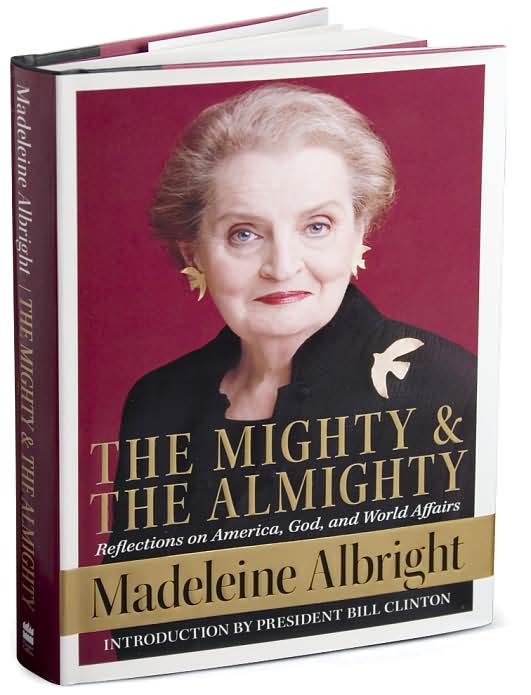
Madeline Albright makes a similar case both in her book "The Mighty and the Almighty" and also in a recent CNN interview. Albright says that we have ignored the importance of faith in the cultures of other countries and she argues that politics and religion must be brought into our search for political solutions in many of the World’s crisis spots.

CNN: In your book, you argue for a better understanding of religion in the U.S. foreign policy arena. Isn't that a revolutionary idea for this generation of diplomats trained more in the realist school of foreign policy?

Albright: As a practitioner of foreign policy, I certainly come from the generation of people who used to say, "X problem is complicated enough. Let's not bring God and religion into it." But through my being in office, and as I explored the subject much further in writing "The Mighty and the Almighty," I really thought that the opposite is true. In order to effectively conduct foreign policy today, you have to understand the role of God and religion. ... My sense is that we don't fully understand, because one, it's pretty complicated, and two, everyone in the U.S. believes in a separation of church and state, so you think, "Well, if we don't believe in the convergence of church and state, then perhaps we shouldn't worry about the role of religion." I think we do that now at our own peril.


Religion is instrumental in shaping ideas and policies. It's an essential part of everyday life in a whole host of countries. And obviously it plays a role in how these countries behave, so we need to know what the religious influence is.

I found the first time I went to Jerusalem, my initial reaction was, people are arguing over all this all the time, it made me think, well, there can't be a God, why would God put up with this? And then I had the total opposite reaction. One that stays with me, which is that there are so many holy places and symbols there, and all anybody talks about is their relationship to those symbols and to God, and therefore the power of God must be so strong there. I just think that it would be much better if people could figure out ... how to agree about it.

CNN: So, therefore, how to figure out the fate Jerusalem is the perfect example of why we need to include religious understanding in our foreign policy.

Albright: Definitely. I am not a theologian, and I have not turned into a religious mystic, but I am a practical problem solver. So I'm looking at religion from the perspective of how knowledge about what people believe in can be useful in terms of trying to resolve the most serious disputes. I think one of the major problems is that here in the United States, particularly, there is very little understanding of Islam. We all act as if Islam is a monolithic religion and that all Muslims live in the Middle East. The bottom line is most Muslims in the world don't live in the Middle East. They live in Indonesia, or Malaysia, or India, um, Pakistan. Second, there are a number of different sects within Islam. Now I think more people understand the difference between Shia and Sunni, but that is just the beginning. We really do not know anything about it
.

Does the U.S.A need more 'religion' in its foreign policy ?

Posted August 21, 2007

Illness As A Gift?

"How can this make me a better person?" - Rabbi Harold Kushner, author of When Bad Things Happen to Good People

In the August 14, 2007 Science section of the NY Times Jane E. Brody writes about “Thriving After Life’s Bum Rap”.

Can getting cancer make you happy? For Betty Rollin, survivor of two breast cancers, there’s no question about it. In her newest book, “Here’s the Bright Side,” Ms. Rollin recounts: “I woke up one morning and realized I was happy. This struck me as weird. Not that I didn’t have all kinds of things to be happy about — love, work, good health, enough money, the usual happy-making stuff. The weird part is, I realized that the source of my happiness was, of all things, cancer — that cancer had everything to do with how good the good parts of my life were.

It turns out there is often — it seems very often — an astonishingly bright side within darkness. People more than survive bum raps: they often thrive on them; they wind up stronger, livelier, happier; they wake up to new insights and new people and do better with the people around them who are not new. In short, they often wind up ahead.”

This is not to suggest that battling cancer is pleasurable. Frustration, anger and grief are natural reactions. Cancer forces people to put their lives on hold. It can cause considerable physical and emotional pain and lasting disfigurement. It may even end in death. But for many people who make it through, and even for some who do not, the experience gives them a new perspective on life and the people in it. It is as if their antennas become more finely tuned by having faced a mortal threat.

As a woman with incurable ovarian cancer recounted this spring in The New York Times: “I treat every day as an adventure, and I refuse to let anything make me sad, angry or worried. I live for the day, which is something I never did before. Believe it or not, I’m happier now than I was before I was diagnosed.”

Michael Feuerstein, a clinical psychologist and author with Patricia Findley of “The Cancer Survivor’s Guide,” was 52 when he was told he had an inoperable brain tumor and was given a year to live. But Dr. Feuerstein didn’t die — he survived extensive debilitating treatment and gained a new outlook. He wrote: “I now realize that I am fortunate. Now, after the cancer, I find I can more easily put life in perspective. I re-evaluated my workload, opting to spend more time at home. I take more time for what matters to me most: my wife and my children and grandchild. I also allocate time to better understand cancer survivorship from a scientific point of view, so I can help others in my situation translate this work into useful answers to the question, ‘now what?’ I am optimistic about the future and excited to leave my unique mark on the world.”

Dr. Harpham is a 16-year survivor of recurrent chronic lymphoma. In her latest book, “Happiness in a Storm: Facing Illness and Embracing Life as a Healthy Survivor,” she states: “Without a doubt, illness is bad, yet survivorship — from the time of diagnosis and for the balance of life — can include times of great joy among the hardships. You can find happiness. Chances are the opportunities for happiness are right in front of you. You might need to explore different ways of seeing yourself and the world around you,” Dr. Harpham writes. “In doing so, you discover new types of happiness waiting to be tapped, such as the happiness of knowing love in a whole new way. Happiness in a storm,” she concludes, “is never about enjoying your illness but embracing your life within the limits of your illness, and figuring out how to feel happy whenever possible.”


Jill Sklar in her book The Five Gifts of Illness’ describes these gifts as Perspective through Adversity, Time and Being, The Purpose in Helping Others, Living Life in Balance, and Resetting the Future. She writes in the introduction to her book:

It was during one of those sleepless nights at the hospital, tossing and turning to try to find a comfortable spot on the plastic covered mattress, that I realized the disease I had wasn’t all bad, that there were wonderful things I had gained because I had suffered. I had known true misery from the illness, but that night I also discovered the proverbial other side of the coin.”

Per aspera ad astra?

Posted August 14, 2007