Showing posts with label Books. Show all posts

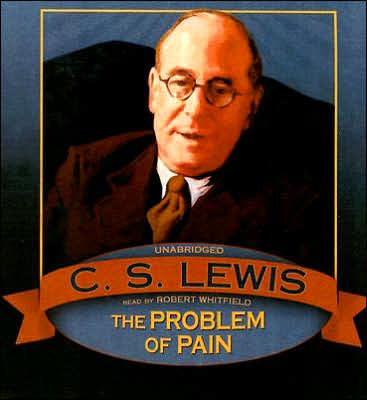
The Problem of Pain

“'If God were good, He would wish to make His creatures perectly happy, and if God were almighty He would be able to do what He wished. But the creatures are not happy. Therefore God lacks either goodness, or power, or both'. This is the problem of pain, in its simplest form." – C. S. Lewis

Jill Heatherly writes: The Problem of Pain answers the universal question, "Why would an all-loving, all-knowing God allow people to experience pain and suffering?" Master Christian apologist C.S. Lewis asserts that pain is a problem because our finite, human minds selfishly believe that pain-free lives would prove that God loves us. In truth, by asking for this, we want God to love us less, not more than he does. "Love, in its own nature, demands the perfecting of the beloved; that the mere 'kindness' which tolerates anything except suffering in its object is, in that respect at the opposite pole from Love." In addressing "Divine Omnipotence," "Human Wickedness," "Human Pain," and "Heaven," Lewis succeeds in lifting the reader from his frame of reference by artfully capitulating these topics into a conversational tone, which makes his assertions easy to swallow and even easier to digest. Lewis is straightforward in aim as well as honest about his impediments, saying, "I am not arguing that pain is not painful. Pain hurts. I am only trying to show that the old Christian doctrine that being made perfect through suffering is not incredible. To prove it palatable is beyond my design." The mind is expanded, God is magnified, and the reader is reminded that he is not the center of the universe as Lewis carefully rolls through the dissertation that suffering is God's will in preparing the believer for heaven and for the full weight of glory that awaits him there. While many of us naively wish that God had designed a "less glorious and less arduous destiny" for his children, the fortune lies in Lewis's inclination to set us straight with his charming wit and pious mind.
Robert Aarhus commented: From a non-Christian POV, I would be surprised if this book made much sense -- so many of the pillars are set on Christian theology, philosophy, and tradition. If you cannot (or will not) accept the possibility of the existence of Heaven, Hell, or God, this book will be just so much incomprehensible babble. But, it is not written for that segment of the market. This book is best read by the thinking Christian who has reservations about aspects of Christianity that seem to gloss over, avoid, or ignore the issue of human suffering.

Lewis analyzes the fundamental question, or problem, of pain: how can God be omnipotent and yet allow pain (war, injury, cruelty, etc.)? Lewis's answer has many levels. Foremost, is that nature had to be created with certain unchangeable properties. For example, the same hardness which allows wood to serve as a beam in my house allows it to serve as an instrument of potential injury, as when that beam collapses and hits my head.


The world also had to be created neutral so that humans could interact equally with one another, i.e., those same, unchanging properties of wood allow it to be manipulated similarly by anyone. But, obviously a neutral world contains the potential for good or evil. Wood can be used to build a home, which is good, or to create a weapon, which is evil. But, this is what makes us human. We have free will.

If I choose evil, God could not intervene. For to intervene some times but not others would be unjust and illogical (this is why miracles, if you believe in them, are extraordinarily rare). And to intervene once is to intervene always. Imagine if God intervened each time one person was going to cause another, or himself, pain. If he did, we all would be puppets, not humans.

Another interesting idea in this book is that of Original Sin. According to Lewis, we have not inherited Adam's sin but instead everyday face Adam's identical choice, perhaps thousands of times a day. For Adam's sin was not disobedience in eating the apple, but in choosing himself over God. Adam had the opportunity to see himself either as a creation or an individual self existing apart from God. Thus, according to Lewis, a final reason for pain, is that it is God's wake-up call that we have, in constantly choosing ourselves, chosen the wrong thing.


Why would a good God create a world in which there is suffering?

Posted April 10, 2010

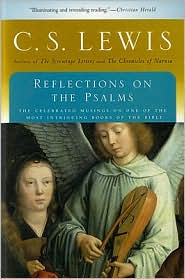
Reflections On The Psalms

“Psalm 19: I take this to be the greatest poem in the Psalter and one of the greatest lyrics in the world" – C. S. Lewis

Reflections on the Psalms was published in 1958. Lewis writes about the difficulties he has met or the joys he has gained in reading the Psalms. He points out that the Psalms are poems, intended to be sung, not doctrinal treatises or sermons. Proceeding with his characteristic grace, he guides readers through both the form and the meaning of these beloved passages in the Bible.

An excellent blog on the books of C.S. Lewis recently had a posting by Christopher Assenza in which he wrote in part:

Many Christians can undoubtedly remember their discomfort upon first encountering invective language in the Psalms, their incredulity at the occasional self-righteousness of the Psalmists, or a general sense of confused wonderment at the Old Testament and how it is interpreted by the Church.

Despite the wide range of reasonable explanations available to them, some Christians nevertheless often wonder how the apparent short-comings they perceive in the Old Testament can be reconciled with their deeply held belief that the Bible is the inspired Word of God. C.S. Lewis experienced the same difficulties. Although not everyone will agree with his approach, Lewis's response to these difficulties is characteristically honest, intelligent, accessible, and, in many ways, comforting. Lewis almost certainly recognized the risk of writing an analytical study of the Bible. This risk, however, is not a deterrent for Lewis, who does not shy away from offering pointed criticism of the Psalms.

In the chapter on cursings, for example, he uses words like “diabolical,” “terrible,” and “contemptible” to describe passages from Psalms 109 and 143 that valorize vengeance, infanticide, and other cruelties (20-1). Most readers who object to this description, however, would be hard-pressed to refute it. Those who do not object and are troubled by its accuracy are likely tempted, as Lewis initially is, to “leave them [the cursing Psalms] alone” (22). Yet, Lewis deftly argues that we cannot deny the malice of these curses, nor can we justify or agree with them because they are in the Bible; instead, we can learn from them about our own inclinations towards hatred, the moral effect our actions can have on others, the distinguishing moral character of the Jewish people that allowed them to experience the temptation to hate (i.e. “they took right and wrong more seriously”), and God's righteous intolerance for sin (20-33).

Why, however, might some object to this reading and others not? The answer is bound up in how Christians understand and relate to the Bible. The “Chicago Statement on Biblical Inerrancy,” a doctrinal statement by an assembly of Protestants written in 1978, describes the Bible as “infallible” and “inerrant,” the latter of which means “the quality of being free from all falsehood or mistake and so safeguards the truth that Holy Scripture is entirely true and trustworthy in all its assertions.” The Catechism of the Catholic Church says much the same thing: “the books of Scripture firmly, faithfully, and without error teach that truth which God, for the sake of salvation, wished to see confided to the Sacred Scriptures.” Both of these documents speak at length about the central, undeniable authority and importance of Scripture in the Christian life, revealing precisely why criticism of the Bible may be threatening to some.

Lewis's assertion that the Old Testament sometimes displays “[n]aïvety, error, contradiction, even... wickedness” quickly dispels any notion that he might have believed the entire Bible to be inerrant in a doctrinal sense, but throughout all of his writing Lewis does affirm the Bible's divine inspiration, its importance, and its authority (111). Lewis's view of Scripture, specifically the Old Testament, rests on many of the core ideas that span his writing, most important of which is his understanding of myth and its role in Christian revelation. Too large a topic to address in detail here, it is enough to say that Lewis saw in the old pagan myths a divinely inspired foreshadowing or anticipation of Truth that is actualized by and through Christ's historical experience on Earth.

Thus something originally merely natural—the kind of myth that is found among most nations—will have been raised by God above itself, qualified by Him and compelled by Him to serve purposes which of itself it would not have served. Generalising this, I take it that the whole Old Testament consists of the same sort of material as any other literature—chronicle (some of it obviously pretty accurate), poems, moral and political diatribes, romances, and what not; but all taken into the service of God's word. ... The total result is not “the Word of God” in the sense that every passage, in itself, gives impeccable science or history. It carries the Word of God; and we (under grace, with attention to tradition and to interpreters wiser than ourselves, and with the use of such intelligence and learning as we may have) receive that word from it not by using it as an encyclopedia or an encyclical but by steeping ourselves in its tone or temper and so learning its overall message. (111)

Lewis shows that this practice of divine “up-grading” is a recurring theme in God's interaction with mankind, manifest most significantly in the Incarnation, when “human life becomes the vehicle of Divine Life” (116). In the same way the “Old Testament is a literature thus 'taken up,' made the vehicle of what is more than human” (117). Understood in this context, the “shadows” of the cursings, when “taken up,” reveal “something more about the light” than any systematic explanation of morality could, confirming, rather than refuting, the divine purpose at work behind the Scriptures (114). Although Lewis was not a strict inerrantist, his views on Scripture have far more in common with traditional, orthodox beliefs than with any modern, liberal notions that deny the Bible's sacredness, divine inspiration, or authority. If nothing else, he uniformly affirms that the spiritual Truth conveyed by the Bible is without error.

In Reflections on the Psalms, Lewis proves this conviction by presenting a way of reading Scripture that accepts the human aspects of its authorship without diluting its inherently divine nature and purpose.

The Psalms - Mere poetry or human authors divinly inspired ?

Posted March 22, 2010

God Has A Problem?

“The problem of suffering has haunted me for a long time. It was what made me begin to think about religion when I was young, and it was what led me to question my faith when I was older. Ultimately, it was the reason I lost my faith" – Bart D. Ehrman

The vindications of God's goodness and justice in the face of the existence of suffering, known as theodicies, are perhaps the most difficult topics of theological discussion. Some argue that suffering leads one to be a better person. Bart Ehrman is dissatisfied with most of the theodices that are current and writes that "my ultimate goal is to examine the biblical responses to suffering. What comes as a surprise is that some of the answers stand at odds with one another".

The cover of Ehrman's book says: In times of questioning and despair, people often quote the Bible to provide answers. Surprisingly, though, the Bible does not have one answer but many "answers" that often contradict one another. Consider these competing explanations for suffering put forth by various biblical writers:

The prophets: suffering is a punishment for sin.

The book of Job, which offers two different answers: suffering is a test, and you will be rewarded later for passing it; and suffering is beyond comprehension, since we are just human beings and God, after all, is God.

Ecclesiastes: suffering is the nature of things, so just accept it.

All apocalyptic texts in both the Hebrew Bible and the New Testament: God will eventually make right all that is wrong with the world.

For Ehrman, the question of why there is so much suffering in the world is more than a haunting thought. Ehrman's inability to reconcile the claims of faith with the facts of real life led the former pastor of the Princeton Baptist Church to reject Christianity. In God's Problem, Ehrman discusses his personal anguish upon discovering the Bible's contradictory explanations for suffering and invites all people of faith--or no faith--to confront their deepest questions about how God engages the world and each of us.

Publishers Weekly commented: In this memoir of his own attempts to answer the great theological question about the persistence of evil in the world, Ehrman refuses to accept the standard theological answers. Through close readings of every section of the Hebrew Bible and the New Testament, he discovers that the Bible offers numerous answers that are often contradictory. The prophets think God sends pain and suffering as a punishment for sin and also that human beings who oppress others create such misery; the writers who tell the Jesus story and the Joseph stories think God works through suffering to achieve redemptive purposes; the writers of Job view pain as God's test; and the writers of Job and Ecclesiastes conclude that we simply cannot know why we suffer. In the end, frustrated that the Bible offers such a range of opposing answers, Ehrman gives up on his Christian faith and fashions a peculiarly utilitarian solution to suffering and evil in the world: first, make this life as pleasing to ourselves as we can and then make it pleasing to others.

Suffering, God's greatest problem?

Bart D. Ehrman is the author of more than twenty books, including the New York Times bestselling Misquoting Jesus. Ehrman is the James A. Gray Distinguished Professor of Religious Studies at the University of North Carolina, Chapel Hill, and is a leading authority on the early Church and the life of Jesus. He has been featured in Time and has appeared on NBC's Dateline, The Daily Show with Jon Stewart, CNN, The History Channel, major NPR shows, and other top media outlets.

Posted March 16, 2008

Essential Reading For Nonbelievers?

"Religion invents a problem where none exists by describing the wicked as also made in the image of god and the sexually nonconformist as existing in a state of incurable mortal sin that can incidentally cause floods and earthquakes." - Christopher Hitchens

The Publisher of Christopher Hitchens' latest book writes:

From the #1 New York Times best-selling author of God Is Not Great, a provocative and entertaining guided tour of atheist and agnostic thought through the ages—with never-before-published pieces by Salman Rushdie, Ian McEwan, and Ayaan Hirsi Ali.

Christopher Hitchens continues to make the case for a splendidly godless universe in this first-ever gathering of the influential voices—past and present—that have shaped his side of the current (and raging) God/no-god debate. With Hitchens as your erudite and witty guide, you'll be led through a wealth of philosophy, literature, and scientific inquiry, including generous portions of the words of Lucretius, Benedict de Spinoza, Charles Darwin, Karl Marx, Mark Twain, George Eliot, Bertrand Russell, Emma Goldman, H. L. Mencken, Albert Einstein, Daniel Dennett, Sam Harris, Richard Dawkins, and many others well-known and lesser known. And they're all set in context and commented upon as only Christopher Hitchens—"political and literary journalist extraordinaire" (Los Angeles Times)—can. Atheist? Believer? Uncertain? No matter: The Portable Atheist will speak to you and engage you every step of the way.

Publishers Weekly said:

Hitchens, an avowed atheist and author of the bestseller God Is Not Great, is a formidable intellectual who finds the notion of belief in God to be utter nonsense. The author is clear in his introduction that religion has caused more than its fair share of world problems. "Religion invents a problem where none exists by describing the wicked as also made in the image of god and the sexually nonconformist as existing in a state of incurable mortal sin that can incidentally cause floods and earthquakes." The readings Hitchens chooses to bolster his atheist argument are indeed engaging and important. Hobbes, Spinoza, Mill and Marx are some of the heavyweights representing a philosophical viewpoint. From the world of literature the author assembles excerpts from Shelley, Twain, Conrad, Orwell and Updike. All are enjoyable to read and will make even religious believers envious of the talent gathered for this anthology. What these dynamic writers are railing against often enough, however, is a strawman: an immature, fundamentalist, outdated, and even embarrassing style of religion that many intelligent believers have long since cast off. It could be that Hitchens and his cast of nonbelievers are preaching to the choir and their message is tired and spent. However, this remains a fascinating collection of readings from some of the West’s greatest thinkers.

A fascinating collection of readings?

Posted December 05, 2007

What's So Great About Christianity?

"Atheists have very clearly said that their goal is to go after our children." - Christian, and Domestic Policy Expert Dinesh D'Souza.
"Theology is not little more than a branch of human ignorance. Indeed it is ignorance with wings." - Author and atheist Sam Harris
"The cosmos is all there is or ever was or ever will be" - Astronomer and TV personality Carl Sagan

Is Christianity obsolete? Do the atheists have it right? Has Christianity been disproven by science, debunked as a force for good, and discredited as a guide to morality? Dinesh D'Souza looks at Christianity with a questioning eye in his book What's So Great About Christianity? in which he also treats atheists with equal skepticism.

Albert Mohler recently interviewed D'Souza about this book:

Albert Mohler: These are interesting days, the public airwaves and so much of the media context is now taken up with the discussion that has featured a great deal of what can be described as militant atheism. Whether it's Christopher Hitchens, Daniel Dennett, Richard Dawkins or Sam Harris or others, there is a new sense that a militant atheism is projecting itself into the public square. Dinesh D'Souza ... has written a new book entitled What's So Great About Christianity. Dinesh, why did you write the book, What's So Great About Christianity?

Dinesh D'Souza: Well, I've been, for 15 years, a secular writer. I've written seven books, but I felt that something new is happening today. That is, we're seeing for the first time atheism become a serious option for people and particularly for young people. A generation ago the poster child of atheism was someone like Madeline Murray O'Hare, or some ACLU lawyer-not a very attractive image for atheism worldwide. Now this atheism is coming out of the universities, they have scientific credentials, or like Christopher Hitchens, they're stylish, they're witty, and many young people are attracted to this kind of thing. I felt that it's important to have, if you will, a twenty-first century apologetic that took the atheist argument seriously-that meets it on it's own ground of reason and science and evidence. That's the goal of What's So Great About Christianity-to challenge atheism on its own terms and defeat it.

Mohler: I think one of the things you acknowledge in your book is that this new breed of militant atheists really looks at what they acknowledge to be the Christian foundations of civilization and argues that they are negative, evil, oppressive, intolerant, and as something we should simply repudiate and grow beyond.

D'Souza: Years ago Bertrand Russell, after he wrote his book, Why I Am Not a Christian, somebody asked him, "If you die and you find yourself before God what would you say?" And Russell, very pompously, said, "I would say, 'Sir, you did not give me enough evidence.'"So, this was the old banner of atheism-it claimed intellectual superiority, this sort of search for evidence. The new atheism, however, is also strangely clothed in the garb of morality. It accuses religion, and specifically Christianity, of being behind most violence and evil and war and suffering-and even terrorism in the world. This is atheism that is flying on the wings of 9/11. It demands a new kind of an answer.

Mohler: You talk about the global triumph of Christianity and the twilight of atheism. If atheism represents so few worldwide, why does it get so much attention?

D'Souza: It gets so much attention because it occupies very influential sectors of American and Western life. Atheism is strong in the universities, it is strong in the media, it is, perhaps, not as strong in politics, but because we have this notion of separation of church and government, the political square is dominated by ... secularists. They figured out a very clever con in which the religious people are driven out of the public square and the atheist idea of fairness is to have a monopoly of the public space. So, for all these reasons, we live in a culture that is publicly secular. If someone was to come from Mars and visit America, and walk around our public buildings, watch television, turn on the music, read books, you would have no idea that a majority of Americans are Christians. You would have no idea that you are in a society that is a Christian society.

Mohler: So when you look at that picture what would you suggest that Christians should do? Simply sit back and make observations about the growing secularism of the elites, or engage the issues?

D'Souza: I think we have a clear biblical mandate to be "not of the world, but in it." We are all told to love God not just with our hearts, but with our minds, and we are told to give the reasons for the hope that is within us. So, I think as Christians we should be in the culture, fully engaged. Not, if you will, conceding all this territory to the atheist because, let's remember, this is not just a debate about putting a monument in a public building. The atheists have very clearly said that their goal is to go after our children. In other words, they know that they have not won the battle for the current generation, but they are hoping that through the schools, and through the universities, as young Christians come into school, come into college-and remember, as in my case, when I went to college I was a Christian, but the Christianity I learned was very juvenile. You could call it Crayon Christianity, and so it was very vulnerable to skeptical assault. So, as Christians we are sending our children off and they are going to get a withering attack on their faith. We've got to prepare ourselves-even more important-we have to prepare them [our children]. We can't just prepare them with, ultimately, scriptural truth, we also have to prepare them with intellectual and moral defenses, so that they can fend off the attacks that will surely come.

Michael Shermer, Publisher of Skeptic magazine said:

“As an unbeliever, I passionately disagree with Dinesh D’Souza on some of his positions. But he is a first-rate scholar whom I feel absolutely compelled to read. His thorough research and elegant prose have elevated him into the top ranks of those who champion liberty and individual responsibility. Now he adds Christianity to his formula for the good society, and although non-Christians and non-theists may disagree with some of his arguments, we ignore him at our peril. D’Souza’s book takes the debate to a new level. Read it.”

On October 22, 2007 at The Kings College Dinesh D'Souza debated Christopher Hitchens under the question “Is Christianity the Problem?”

Dinesh D'Souza, a former White House domestic policy analyst, is currently the Rishwain Research Scholar at the Hoover Institution at Stanford University. He is the bestselling author of What's So Great About America, Ronald Reagan: How an Ordinary Man Became an Extraordinary Leader, and many other books.

Is Christianity A Problem?

Posted November 24, 2007

God Is A Fundamentalist?

"The Mythos of a society provided people with a context that made sense of their day-to-day lives; it directed their attention to the eternal and the universal. Logos was the rational, pragmatic, and scientific thought that enabled men and women to function well in the world. We may have lost the sense of mythos in the West today, but we are very familiar with logos, which is the basis of our society" - Karen Armstrong

Karen Armstrong is the author of nearly twenty books, including The Great Transformation, and The Spiral Staircase, a spiritual memoir. An internationally renowned expert on religion, Armstrong is a powerful voice for interfaith understanding.

Armstrong's latest 'bestseller' The Battle For God - A History of Fundamentalism is a highly readable account of how the world today faces a clash between religious fundamentalism and secularism.

Library Journal's review of the book said: Armstrong, author of A History of God and other books on the Jewish, Christian, and Muslim religions, writes very perceptively about the intense fear of modernity that has stimulated various fundamentalisms: Protestant, in the United States; Jewish, in Israel; Sunni Muslim, in Egypt; and Shii Muslim, in Iran. Each is ultimately modern in its attempts at converting mythic thinking into logical thinking and in its use of widespread literacy and the democratic ideas about individual importance that modernity fostered, but each is also at war with its liberal co-religionists and with secularists who "have entirely different conceptions of the sacred." Armstrong concludes that both sides--fundamentalists and secularists (including governments)--need compassion in order to be true to their own religious or humanistic values. The historical range and depth of this work, which transcends other treatments of the subject, make this highly recommended for all libraries.

Ray Olsen writing for Booklist commented: Combining synoptic and interpretive historical manners, Armstrong, author of the widely read and well-received History of God (1993), produces another splendid book that, for the considerable readership interested in religion, may prove to be a page-turner. The subject is fundamentalism in the world's great monotheisms--Judaism, Christianity, and Islam. Armstrong represents the dissimilar movements called fundamentalist as fearful reactions to modernity, especially the modernist predispositions for materialist reason and empirical evidence, which have increasingly encouraged denying the validity, or even the possibility, of truths expressed by the symbolic systems of religion. But, she maintains, these fundamentalisms are themselves typical products of modernity, for they tacitly accept the modern scientific devaluation of religious mythos by insisting on the literal truth of sacred writings, as in Christian fundamentalists' use of the New Testament Book of Revelation as a set of predictions of particular historical events and persons. Armstrong works out her interpretation by historically tracing the challenge of modernity and the fundamentalist reaction in the three monotheisms as parallel developments that span some 1,500 years. The typically modern pressure of politics upon religion began in the Middle Ages (Islam has never been free of it). A crucial date is 1492, when Ferdinand and Isabella ordered the expulsion of Jews and Muslims from the first rational modern state, their united kingdom of Spain, even as they dispatched Columbus, probably a Christianized Jew, in the opening salvo of modern imperialism. Intriguingly, Armstrong says the modernizing process had been launched earlier in the century by the Inquisition--a statement provocative enough to current ideas of what's modern to hook many readers, none of whom will later be the least bit dismayed about having taken the bait.

At the end of the book are a series of fourteen discussion topics which arise from the book's theme and which should aid readers in formulating comments for discussion in this thread.

Is there a battle for God?

Posted November 10, 2007

To Regret Religion Is To Regret Western Civilization?

"If you empty the world of purpose, make it one of brute fact alone, you empty it of reasons for gratitude, and a sense of gratitude is necessary for both happiness and decency" - Theodore Dalrymple

There has been a recent spate of books by atheists Daniel Dennett, A. C. Grayling, Richard Dawkins, and Christopher Hitchens condemning religion. Books by the Christian authors Alister McGrath and John C. Lennox have been written in reply as have several excellent reviews notably that by Terry Eagleton in the London Review of Books.

Theodore Dalrymple, who describes himself as a non-believer, has found the attack on religion to be somewhat blind and makes this case in his article What the New Atheists Don’t See which appeared in the Autumn 2007 issue of City Journal, Volume 17, No. 4. Dalrymple wrote in part:

The British parliament’s first avowedly atheist member, Charles Bradlaugh, would stride into public meetings in the 1880s, take out his pocket watch, and challenge God to strike him dead in 60 seconds. God bided his time, but got Bradlaugh in the end. Few of us, especially as we grow older, are entirely comfortable with the idea that life is full of sound and fury but signifies nothing. However much philosophers tell us that it is illogical to fear death, and that at worst it is only the process of dying that we should fear, people still fear death as much as ever. In like fashion, however many times philosophers say that it is up to us ourselves, and to no one else, to find the meaning of life, we continue to long for a transcendent purpose immanent in existence itself, independent of our own wills. To tell us that we should not feel this longing is a bit like telling someone in the first flush of love that the object of his affections is not worthy of them. The heart hath its reasons that reason knows not of.

The search for the pure guiding light of reason, uncontaminated by human passion or metaphysical principles that go beyond all possible evidence, continues, however; and recently, an epidemic rash of books has declared success, at least if success consists of having slain the inveterate enemy of reason, namely religion. The philosophers Daniel Dennett, A. C. Grayling, Michel Onfray, and Sam Harris, biologist Richard Dawkins, and journalist and critic Christopher Hitchens have all written books roundly condemning religion and its works. Evidently, there is a tide in the affairs, if not of men, at least of authors.

The curious thing about these books is that the authors often appear to think that they are saying something new and brave. Yet with the possible exception of Dennett’s, they advance no argument that I, the village atheist, could not have made by the age of 14. Dennett’s Breaking the Spell is the least bad-tempered of the new atheist books, but it is deeply condescending to all religious people. For Dennett, to prove the biological origin of belief in God is to show its irrationality, to break its spell. But of course it is a necessary part of the argument that all possible human beliefs, including belief in evolution, must be explicable in precisely the same way; or else why single out religion for this treatment? Either we test ideas according to arguments in their favor, independent of their origins, thus making the argument from evolution irrelevant, or all possible beliefs come under the same suspicion of being only evolutionary adaptations—and thus biologically contingent rather than true or false. We find ourselves facing a version of the paradox of the Cretan liar: all beliefs, including this one, are the products of evolution, and all beliefs that are products of evolution cannot be known to be true.

One striking aspect of Dennett’s book is his failure to avoid the language of purpose, intention, and ontological moral evaluation, despite his fierce opposition to teleological views of existence: the coyote’s “methods of locomotion have been ruthlessly optimized for efficiency.” Or: “The stinginess of Nature can be seen everywhere we look.” Or again: “This is a good example of Mother Nature’s stinginess in the final accounting combined with absurd profligacy in the methods.” No doubt Dennett would reply that he is writing in metaphors for the layman and that he could translate all his statements into a language without either moral evaluation or purpose included in it.

Dennett is not the only new atheist to employ religious language. In The God Delusion, Richard Dawkins quotes with approval a new set of Ten Commandments for atheists, which he obtained from an atheist website, without considering odd the idea that atheists require commandments at all, let alone precisely ten of them; nor does their metaphysical status seem to worry him. The last of the atheist’s Ten Commandments ends with the following: “Question everything.” Everything? Including the need to question everything, and so on ad infinitum? Not to belabor the point, but if I questioned whether George Washington died in 1799, I could spend a lifetime trying to prove it and find myself still, at the end of my efforts, having to make a leap, or perhaps several leaps, of faith in order to believe the rather banal fact that I had set out to prove. Metaphysics is like nature: though you throw it out with a pitchfork, yet it always returns. What is confounded here is surely the abstract right to question everything with the actual exercise of that right on all possible occasions. Anyone who did exercise his right on all possible occasions would wind up a short-lived fool.

Lying not far beneath the surface of all the neo-atheist books is the kind of historiography that many of us adopted in our hormone-disturbed adolescence, furious at the discovery that our parents sometimes told lies and violated their own precepts and rules. It can be summed up in Christopher Hitchens’s drumbeat in God Is Not Great: “Religion spoils everything.” In fact, one can write the history of anything as a chronicle of crime and folly. Science and technology spoil everything: without trains and IG Farben, no Auschwitz; without transistor radios and mass-produced machetes, no Rwandan genocide. First you decide what you hate, and then you gather evidence for its hatefulness. Since man is a fallen creature (I use the term metaphorically rather than in its religious sense), there is always much to find.

The thinness of the new atheism is evident in its approach to our civilization … To regret religion is, in fact, to regret our civilization and its monuments, its achievements, and its legacy. If you empty the world of purpose, make it one of brute fact alone, you empty it … of reasons for gratitude, and a sense of gratitude is necessary for both happiness and decency. For what can soon, and all too easily, replace gratitude is a sense of entitlement. Without gratitude, it is hard to appreciate, or be satisfied with, what you have: and life will become an existential shopping spree that no product satisfies.

A few years back, the National Gallery held an exhibition of Spanish still-life paintings. One of these paintings had a physical effect on the people who sauntered in, stopping them in their tracks; some even gasped. I have never seen an image have such an impact on people. The painting (Quince, Cabbage, Melon and Cucumber, 1602), by Juan Sánchez Cotán, now hangs in the San Diego Museum of Art. It showed four fruits and vegetables, two suspended by string, forming a parabola in a gray stone window. Even if you did not know that Sánchez Cotán was a seventeenth-century Spanish priest, you could know that the painter was religious: for this picture is a visual testimony of gratitude for the beauty of those things that sustain us. Once you have seen it, and concentrated your attention on it, you will never take the existence of the humble cabbage—or of anything else—quite so much for granted, but will see its beauty and be thankful for it. The painting is a permanent call to contemplation of the meaning of human life…..

I recently had occasion to compare the writings of the neo-atheists with those of Anglican divines of the seventeenth and eighteenth centuries. In my own neo-atheist days, I would have scorned these works as pertaining to a nonexistent entity and containing nothing of value. But looking, say, into the works of Joseph Hall, D.D., I found myself moved: much more moved, it goes without saying, than by any of the books of the new atheists. Hall was bishop of Exeter and then of Norwich; though a moderate Puritan, he took the Royalist side in the English civil war and lost his see, dying in 1656 while Cromwell was still Lord Protector. Except by specialists, Hall remains almost entirely forgotten today. I opened one of the volumes at random, his Contemplations Upon the Principal Passages of the Holy Story. Here was the contemplation on the sickness of Hezekiah:


Hezekiah was freed from the siege of the Assyrians, but he is surprised with a disease. He, that delivered him from the hand of his enemies, smites him with sickness. God doth not let us loose from all afflictions, when he redeems us from one. To think that Hezekiah was either not thankful enough for his deliverance, or too much lifted up with the glory of so miraculous a favour, were an injurious misconstruction of the hand of God, and an uncharitable censure of a holy prince; for, though no flesh and blood can avoid the just desert of bodily punishment, yet God doth not always strike with an intuition of sin: sometimes he regards the benefit of our trial; sometimes, the glory of his mercy in our cure.

Hall surely means us to infer that whatever happens to us, however unpleasant, has a meaning and purpose; and this enables us to bear our sorrows with greater dignity and less suffering. And it is part of the existential reality of human life that we shall always need consolation, no matter what progress we make. This is the language not of rights and entitlements, but of something much deeper—a universal respect for the condition of being human. For Hall, life is instinct with meaning: a meaning capable of controlling man’s pride at his good fortune and consoling him for his ill fortune.

In his 'Occasional Meditations', Hall takes perfectly ordinary scenes—ordinary, of course, for his times—and derives meaning from them. Here is his meditation “Upon the Flies Gathering to a Galled Horse”:

How these flies swarm to the galled part of this poor beast; and there sit, feeding upon that worst piece of his flesh, not meddling with the other sound parts of his skin! Even thus do malicious tongues of detractors: if a man have any infirmity in his person or actions, that they will be sure to gather unto, and dwell upon; whereas, his commendable parts and well-deservings are passed by, without mention, without regard. It is an envious self-love and base cruelty, that causeth this ill disposition in men: in the mean time, this only they have gained; it must needs be a filthy creature, that feeds upon nothing but corruption.

Surely Hall is not suggesting (unlike Dennett in his unguarded moments) that the biological purpose of flies is to feed off injured horses, but rather that a sight in nature can be the occasion for us to reflect imaginatively on our morality. He is not raising a biological theory about flies, in contradistinction to the theory of evolution, but thinking morally about human existence. It is true that he would say that everything is part of God’s providence, but, again, this is no more (and no less) a metaphysical belief than the belief in natural selection as an all-explanatory principle.

Theodore Dalrymple, a physician, is a contributing editor of City Journal and the Dietrich Weismann Fellow at the Manhattan Institute.

What don't atheists see?

Posted October 31, 2007

Who is John Galt?

""I swear by my life and my love of it I will never live for the sake of another man, nor ask another man to live for mine." - John Galt in Atlas Shrugged.

First Things in an October 11, 2007 article by Brian Murray entitled “Who is John Galt? And Does Anyone Care Anymore?” discusses the influence of Ayn Rand on the fiftieth anniversary of the publication of her novel “Atlas Shrugged”. Murray writes:

Atlas Shrugged was a huge, hotly debated bestseller in its day, and its sales have held steady ever since. Its author, certainly, retains a certain mystique as the exacting thinker still revered by many Americans as a great intellectual and seer. All of us, surely, know someone who has passed through an Ayn Rand phrase, mild or severe. At some point we’ve all heard the words: “Atlas Shrugged changed my life.”

Ayn Rand took herself very seriously indeed. She was a born iconoclast and provocateur: one of those restless souls forever seeking to bend the world to her will. She was not easily impressed, deciding early on that nearly all philosophy after Aristotle was a waste of time. One day, Rand famously assured her university professors, she would produce timeless philosophical writings of her own. She had very little humor but plenty of push.

First, however, she would write movies and plays. Alicia Rosenbaum—as her family knew Ayn Rand—spent much of her childhood reading far-fetched novels featuring square-jawed adventurers in exotic locales. Besides Aristotle, Rand’s heroes were all fictional he-men—late Victorian versions of Indiana Jones. When, in 1926, Rand left her native Russia for the United States, she headed straight for Hollywood, where in short order she found a husband, took an extra’s part in Cecil B. De Mille’s The King of Kings, and started cranking out scripts. Alicia Rosenbaum became Ayn Rand, the headstrong heroine of a decidedly American story.

Rand’s educated, prosperous family suffered terribly under the Soviets, and her hatred of communism burned on like a hard, gemlike flame. But she loved the United States in her own, highly stylized way: She loved its skyscrapers, its technology, its machinery, its energy. Rand’s first big bestseller, The Fountainhead (1940), is in part a long hymn to this America of her imagination, and its hero, Howard Roark, is her first extended portrait of the consummate American—a world-class architect based loosely on Frank Lloyd Wright.

Rand’s Ideal Man could never be a schoolteacher, say, or a physical therapist, or a claims clerk in the Social Security Administration. He must not be short-winded or fat. He must be perfection in action—gifted and brave, uniquely talented, and utterly free of irrationality and fear. He must, like Roark, defend the premise that no man should ever compromise his individual will or submit to pathetic notions of “sacrifice”; he must recognize that men of genius like himself will forever fight the lazy, inferior parasites who seek to take what superior minds have made. He must, in short, look like Gary Cooper and think exactly like Ayn Rand. As The Fountainhead showed, Rand’s beliefs were well-suited for the big screen, where outsize heroes, defiant acts, and stirring speeches have always been the order of the day.

Rand hated religion as much as she hated communism; for her Christianity was, of course, the religion of fools and slaves. Rand’s “marginalia,” culled from the books in her library and published in 1998, are particularly revealing: The woman who despised emotionalism and valued reason above all became, when faced with C.S. Lewis, like one of those “literary guys” faced with Mickey Spillane. Lewis, Rand averred, was a “driveling non-entity,” a “mediocrity,” and “scum.”

Still, Atlas Shrugged, you’ve heard countless times, is a classic, and apparently it’s soon to be a major motion picture starring Angelina Jolie. And so, finally, you’re ready to give it a go—all 1,168 pages. It is full of rich characters: They own steel mills and railroads. Otherwise they’re ponderous and flat. It’s possible, then, that early on your eyes might start to glaze a bit, and you’ll find yourself thinking “Really, I couldn’t care less” each time the novel demands: “Who is John Galt?” It’s very possible, actually, because fifty years after its publication Atlas Shrugged is much better as a doorstop than a novel.

Atlas Shrugged – Good novel or good doorstop?.

Posted October 17, 2007

Has Science Buried God?

"What is the meaning of it all?" Richard Feynman - American physicist known for expanding the theory of quantum electrodynamics.
"The universe is just there, and that's all." Bertrand Russell - English philosopher, historian, logician, mathematician, advocate for social reform, pacifist, and prominent Rationalist.
"It is the very nature of science that leads me to belief in God," John C Lennox - a popular Christian apologist and scientist.

Adam Kirsch wrote a review of a new book on Thomas Hardy by Claire Tomalin for The New Yorker magazine entitled 'God’s Undertaker: How Thomas Hardy became everyone’s favorite misanthrope' and in it Kirsch writes:

“One Sunday morning in the middle of the nineteenth century, at a church in the Dorset village of Stinsford, a boy named Thomas Hardy had an experience that, more than sixty years later, he remembered as causing him “much mental distress.” As the boy watched the priest deliver the sermon, Hardy recalled in his autobiography, “some mischievous movement of his mind set him imagining that the vicar was preaching mockingly, and he began trying to trace a humorous twitch in the corners of Mr. S—’s mouth, as if he could hardly keep a serious countenance. Once having imagined this the impish boy found to his consternation that he could not dismiss the idea.”
If the Reverend Arthur Shirley, whose name Hardy courteously omitted, had noticed his young parishioner’s amusement, he would not have recognized it for what it was: the first scratching of the seismograph that, within the boy’s lifetime, would register the death of God. Hardy’s “merriment,” as he quietly but unmistakably shows, was the product of his dawning sense that nobody, not even the priest, could possibly take the church service seriously. There seems to be a straight line, if not a short one, from Hardy’s “consternation” to the madness of the stranger who, in Nietzsche’s famous parable, barges into churches to sing a requiem: “What after all are these churches now if they are not the tombs and sepulchres of God?”


John C. Lennox in his book God’s Undertaker: Has Science Buried God offers a response to the claims of more modern atheists, such as Richard Dawkins and Christopher Hitchens, that science has finally killed the idea of God. Lennox argues that indeed the reverse is more likely to have validity and based on the evaluation of modern scientific evidence he argues that theism is more in tune with science than atheism. The book’s publisher writes:

“If we believe many modern commentators, science has squeezed God into a corner, killed and then buried Him with its all-embracing explanations. Atheism, we are told, is the only intellectually tenable position, and any attempt to reintroduce God is likely to impede the progress of science. John Lennox invites us to consider such claims very carefully. Is it really true, he asks, that everything in science points towards atheism? Could it be possible that theism sits more comfortably with science than atheism?”

Fixed Point hosted a debate between Dawkins and Lennox on the positions taken by their respective books. Copies of the debate can be obtained on the Fixed Point website.

John Lennox has published over 70 articles in Algebra (Group Theory) and co-authored two research monographs in the Oxford Mathematical Monographs series - "The Theory of Subnormal Subgroups" (with S.E. Stonehower) 1987 and "The Theory of Infinite Soluble Groups" (with D.J.S. Robinson) 2004. He is currently particularly interested in the interface between science, philosophy and theology and lectures in Science and Religion at Oxford University.

Science is God's Undertaker?

Posted October 07, 2007

God's Attorney Met The Atheistic Jew?

"There are also two kinds of truths: truths of reasoning and truths of fact. Truths of reasoning are necessary and their opposite is impossible; those of fact are contingent and their opposite is possible" - Gottfried Leibniz

"Be not astonished at new ideas; for it is well known to you that a thing does not therefore cease to be true because it is not accepted by many” - Baruch Spinoza.

We have had interesting discussions recently on a couple of books in which two philosophers had come into some intellectual or philosophical conflict - Rousseau's Dog involving Hume/Rousseau and Wittgenstein's Poker involving Popper/Wittgenstein.

The next book in this series, The Courtier and the Heretic, involves the opposing world views of Leibniz and Spinoza. The book publisher writes that "philosophy in the late seventeenth century was a dangerous business. No careerist could afford to know the reclusive, controversial philosopher Baruch de Spinoza. Yet the wildly ambitious genius Gottfried Wilhelm Leibniz, who denounced Spinoza in public, became privately obsessed with Spinoza’s ideas, wrote him clandestine letters, and ultimately met him in secret".

Writing in The New York Times Liesl Schillinger said: - With The Courtier and the Heretic, Stewart has achieved a near impossibility, creating a page-turner about jousting metaphysical ideas that casts the hallowed, hoary thinkers as warriors in a heated ideological battle. He reveals early on that he believes the battle was one-sided, and that both men fought for the same cause. Even so, the conflict, as he paints it, is no less compelling for ending in a draw. This is a harder trick to pull off than it may sound because Stewart's rivals are both relatively unknown to modern nonspecialists. In other words, he has to acquaint his readers with both his main characters before he can unspool his take on their story.

Publishers Weekly review stated: According to Nietzsche, "Every great philosophy is... a personal confession of its creator and a kind of involuntary and unperceived memoir.". Stewart affirms this maxim in his colorful reinterpretation of the lives and works of 17th-century philosophers Spinoza and Leibniz. In November 1676, the foppish courtier Leibniz, "the ultimate insider... an orthodox Lutheran from conservative Germany," journeyed to The Hague to visit the self-sufficient, freethinking Spinoza, "a double exile... an apostate Jew from licentious Holland." A prodigious polymath, Leibniz understood Spinoza's insight that "science was in the process of rendering the God of revelation obsolete; that it had already undermined the special place of the human individual in nature." Spinoza embraced this new world. Seeing the orthodox God as a "prop for theocratic tyranny," he articulated the basic theory for the modern secular state. Leibniz, on the other hand, spent the rest of his life championing God and theocracy like a defense lawyer defending a client he knows is guilty. He elaborated a metaphysics that was, at bottom, a reaction to Spinoza and collapses into Spinozism, as Stewart deftly shows. For Stewart, Leibniz's reaction to Spinoza and modernity set the tone for "the dominant form of modern philosophy" a category that includes Kant, Hegel, Bergson, Heidegger and "the whole `postmodern' project of deconstructing the phallogocentric tradition of western thought." Readers of philosophy may find much to disagree with in these arguments, but Stewart's wit and profluent prose make this book a fascinating read.

Did Leibniz and Spinoza decide the 'fate of God' in the modern world?

Posted September 05, 2007

What is Painting?

"The answer to the question “What is Painting?” is simple and clear. The answer is “Who cares?” - Morgan Meis, an arts collective in New York.

The Smart Set from Drexel University is an online publication covering culture and ideas, arts and sciences, global and national affairs. A recent article by Morgan Meis entitled “A Dilettante's Guide to Art” reviews the book “1001 Paintings You Should See Before You Die” by Stephen Farthing and poses the question "What is Painting?" The answer: "Who cares?"

Meis writes: Sometime in the middle of the 19th century painting started to get a little screwed up. It began to worry. Painters stopped simply doing what they were doing and started spending more and more time trying to figure out what they were doing and why. They got into the "What Is?" question. "What is Painting?", "What is Art?" "What Is…?"

It’s hard to blame them for it. The "What Is?" question was in the air. Chalk it up to the vast and traumatic transformations that ushered in modern times. Everybody was trying to figure out what was different and what was still the same. In painting, the biggest change was in the abandonment of representation as the central task. Nobody was interested in problems of perspective anymore, in figuring out how best to make the world of three dimensions look vaguely like itself on the canvas of two dimensions. And yet, for some reason, people still felt the desire to paint. Who knows why? Maybe it was just the need to hold on to a little tradition even as so much else was being swept away. Maybe it was the hope that an old practice could remake itself in a new world. Whatever the explanation, painting managed to remake itself and painters rushed into the 20th century with purpose. They had discovered a new subject matter, painting itself, and they were hot to show off its possibilities. Painting took on a double task, not just to do what it was doing, but also to make a claim about what it should be doing. Painters started talking about painting within their own paintings.

Malevich’s famous White on White comes to mind. It was, basically, one white square painted on top of another white square. It is a lovely painting in its own right, but it is also a manifesto in pigment. When Malevich painted those white squares he was also asking what painting could be, what it was about, what it should and shouldn’t be. Malevich was obsessed with the idea that art had to be freed from its relationship to the object. He thought that art should go after something more pure, perhaps touching on the realm of purity itself, wherever that is. His paintings thus asked the “What Is?” question and proposed to answer it simultaneously. His answer was that painting ought to be about truth and that truth is a simple and geometrical thing.

The amazing thing about 1001 Paintings is thus the breeziness of it all. It is a dilettante’s book …… the dilettantes are always right, because paintings are for looking at, and because every claim about what painting “should be” gets shriveled and old and academic even before the canvas does. The dilettante doesn’t care much about what painting “should be,” only about what it is and has been. And the thing that keeps this standpoint from being utterly trivial is the hint of melancholy in it. The dilettante is interested in all things equally because in the long eye of time all things are equally transient. Looking can become delightful again from that perspective, but it is tinged with the mark of death. The dilettante acknowledges this mark, and then goes about the business of living.

The answer that the book thus gives to the question “What is Painting?” is simple and clear. The answer is “Who cares?”

What painting(s) do you care about? Give the name and I will supply the link.

Posted August 29, 2007

Ask The Almighty?

"I am not a theologian, and I have not turned into a religious mystic, but I am a practical problem solver. So I'm looking at religion from the perspective of how knowledge about what people believe in can be useful in terms of trying to resolve the most serious disputes." - Madeline Albright

Mark Lilla, professor of the humanities at Columbia University, wrote an essay in the NY times entitled “The Politics of God" adapted from his book “The Stillborn God: Religion, Politics and the Modern West" in which he suggests that religious passions lie at the heart of world politics and we need to bring religion into their solution.
Lilla writes: Today, we have progressed to the point where our problems again resemble those of the 16th century, as we find ourselves entangled in conflicts over competing revelations, dogmatic purity and divine duty. We in the West are disturbed and confused. Though we have our own fundamentalists, we find it incomprehensible that theological ideas still stir up messianic passions, leaving societies in ruin. We had assumed this was no longer possible, that human beings had learned to separate religious questions from political ones, that fanaticism was dead. We were wrong.

A little more than two centuries ago we began to believe that the West was on a one-way track toward modern secular democracy and that other societies, once placed on that track, would inevitably follow. Though this has not happened, we still maintain our implicit faith in a modernizing process and blame delays on extenuating circumstances like poverty or colonialism. This assumption shapes the way we see political theology, especially in its Islamic form — as an atavism requiring psychological or sociological analysis but not serious intellectual engagement. Islamists, even if they are learned professionals, appear to us primarily as frustrated, irrational representatives of frustrated, irrational societies, nothing more.

We live, so to speak, on the other shore. When we observe those on the opposite bank, we are puzzled, since we have only a distant memory of what it was like to think as they do. We all face the same questions of political existence, yet their way of answering them has become alien to us. On one shore, political institutions are conceived in terms of divine authority and spiritual redemption; on the other they are not. And that, as Robert Frost might have put it, makes all the difference. Understanding this difference is the most urgent intellectual and political task of the present time.

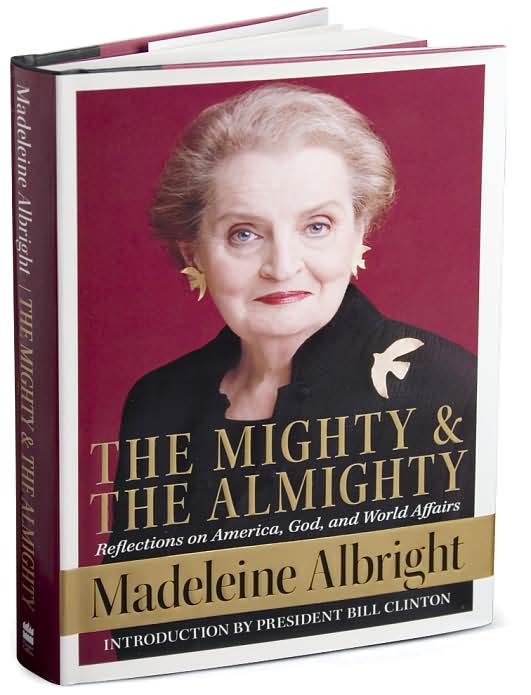
Madeline Albright makes a similar case both in her book "The Mighty and the Almighty" and also in a recent CNN interview. Albright says that we have ignored the importance of faith in the cultures of other countries and she argues that politics and religion must be brought into our search for political solutions in many of the World’s crisis spots.

CNN: In your book, you argue for a better understanding of religion in the U.S. foreign policy arena. Isn't that a revolutionary idea for this generation of diplomats trained more in the realist school of foreign policy?

Albright: As a practitioner of foreign policy, I certainly come from the generation of people who used to say, "X problem is complicated enough. Let's not bring God and religion into it." But through my being in office, and as I explored the subject much further in writing "The Mighty and the Almighty," I really thought that the opposite is true. In order to effectively conduct foreign policy today, you have to understand the role of God and religion. ... My sense is that we don't fully understand, because one, it's pretty complicated, and two, everyone in the U.S. believes in a separation of church and state, so you think, "Well, if we don't believe in the convergence of church and state, then perhaps we shouldn't worry about the role of religion." I think we do that now at our own peril.


Religion is instrumental in shaping ideas and policies. It's an essential part of everyday life in a whole host of countries. And obviously it plays a role in how these countries behave, so we need to know what the religious influence is.

I found the first time I went to Jerusalem, my initial reaction was, people are arguing over all this all the time, it made me think, well, there can't be a God, why would God put up with this? And then I had the total opposite reaction. One that stays with me, which is that there are so many holy places and symbols there, and all anybody talks about is their relationship to those symbols and to God, and therefore the power of God must be so strong there. I just think that it would be much better if people could figure out ... how to agree about it.

CNN: So, therefore, how to figure out the fate Jerusalem is the perfect example of why we need to include religious understanding in our foreign policy.

Albright: Definitely. I am not a theologian, and I have not turned into a religious mystic, but I am a practical problem solver. So I'm looking at religion from the perspective of how knowledge about what people believe in can be useful in terms of trying to resolve the most serious disputes. I think one of the major problems is that here in the United States, particularly, there is very little understanding of Islam. We all act as if Islam is a monolithic religion and that all Muslims live in the Middle East. The bottom line is most Muslims in the world don't live in the Middle East. They live in Indonesia, or Malaysia, or India, um, Pakistan. Second, there are a number of different sects within Islam. Now I think more people understand the difference between Shia and Sunni, but that is just the beginning. We really do not know anything about it
.

Does the U.S.A need more 'religion' in its foreign policy ?

Posted August 21, 2007

Illness As A Gift?

"How can this make me a better person?" - Rabbi Harold Kushner, author of When Bad Things Happen to Good People

In the August 14, 2007 Science section of the NY Times Jane E. Brody writes about “Thriving After Life’s Bum Rap”.

Can getting cancer make you happy? For Betty Rollin, survivor of two breast cancers, there’s no question about it. In her newest book, “Here’s the Bright Side,” Ms. Rollin recounts: “I woke up one morning and realized I was happy. This struck me as weird. Not that I didn’t have all kinds of things to be happy about — love, work, good health, enough money, the usual happy-making stuff. The weird part is, I realized that the source of my happiness was, of all things, cancer — that cancer had everything to do with how good the good parts of my life were.

It turns out there is often — it seems very often — an astonishingly bright side within darkness. People more than survive bum raps: they often thrive on them; they wind up stronger, livelier, happier; they wake up to new insights and new people and do better with the people around them who are not new. In short, they often wind up ahead.”

This is not to suggest that battling cancer is pleasurable. Frustration, anger and grief are natural reactions. Cancer forces people to put their lives on hold. It can cause considerable physical and emotional pain and lasting disfigurement. It may even end in death. But for many people who make it through, and even for some who do not, the experience gives them a new perspective on life and the people in it. It is as if their antennas become more finely tuned by having faced a mortal threat.

As a woman with incurable ovarian cancer recounted this spring in The New York Times: “I treat every day as an adventure, and I refuse to let anything make me sad, angry or worried. I live for the day, which is something I never did before. Believe it or not, I’m happier now than I was before I was diagnosed.”

Michael Feuerstein, a clinical psychologist and author with Patricia Findley of “The Cancer Survivor’s Guide,” was 52 when he was told he had an inoperable brain tumor and was given a year to live. But Dr. Feuerstein didn’t die — he survived extensive debilitating treatment and gained a new outlook. He wrote: “I now realize that I am fortunate. Now, after the cancer, I find I can more easily put life in perspective. I re-evaluated my workload, opting to spend more time at home. I take more time for what matters to me most: my wife and my children and grandchild. I also allocate time to better understand cancer survivorship from a scientific point of view, so I can help others in my situation translate this work into useful answers to the question, ‘now what?’ I am optimistic about the future and excited to leave my unique mark on the world.”

Dr. Harpham is a 16-year survivor of recurrent chronic lymphoma. In her latest book, “Happiness in a Storm: Facing Illness and Embracing Life as a Healthy Survivor,” she states: “Without a doubt, illness is bad, yet survivorship — from the time of diagnosis and for the balance of life — can include times of great joy among the hardships. You can find happiness. Chances are the opportunities for happiness are right in front of you. You might need to explore different ways of seeing yourself and the world around you,” Dr. Harpham writes. “In doing so, you discover new types of happiness waiting to be tapped, such as the happiness of knowing love in a whole new way. Happiness in a storm,” she concludes, “is never about enjoying your illness but embracing your life within the limits of your illness, and figuring out how to feel happy whenever possible.”


Jill Sklar in her book The Five Gifts of Illness’ describes these gifts as Perspective through Adversity, Time and Being, The Purpose in Helping Others, Living Life in Balance, and Resetting the Future. She writes in the introduction to her book:

It was during one of those sleepless nights at the hospital, tossing and turning to try to find a comfortable spot on the plastic covered mattress, that I realized the disease I had wasn’t all bad, that there were wonderful things I had gained because I had suffered. I had known true misery from the illness, but that night I also discovered the proverbial other side of the coin.”

Per aspera ad astra?

Posted August 14, 2007

A Poker for Popper?

"God has arrived. I met him on the 5:15 train" - John Maynard Keynes speaking of Ludwig Wittgenstein.

Edmonds and Eidinow described a lifetime squabble between Rousseau and Hume in Rousseau's Dog. In this book they deal with a ten-minute spat between two equally illustrious philosophers, Wittgenstein and Popper.

On October 25, 1946, in a crowded room in Cambridge, England, Ludwig Wittgenstein and Karl Popper came face to face for the first and only time. The meeting did not go well. Their loud and aggressive confrontation became the stuff of instant legend. But precisely what happened in those ten minutes remains the subject of intense disagreement. Amost immediately, rumors spread around the world that the two great philosophers had come to blows, armed with red-hot pokers.

What really wnet on in that room? And what does the violence of this brief exchange tell us about these two men, modern philosophy, post-war culture, and the difference between global problems and logic puzzles?

Wittgenstein's Poker is an engaging mix of philosophy, history, biography, and literary detection. At the center of the story stand the two philosophers themselves: proud, irascible, larger than life—and spoiling for a fight.

The third man in this story is Bertrand Russell. Wittgenstein was Russell's brilliant pupil whom Russell looked upon as his natural philosophical heir. However, Wittgenstein came to regard Russell as his intellectual inferior and later in life told the American philosopher O.K. Bouwsma that they "passed but did not speak". Russell had given minor assistance to Popper in the furtherance of his career and did not know or respect him to the extent that he did Wittgenstein. Popper's attitude to Russell according to their contemporary Peter Munz was "verging on hero-worship".

In his review of this book Enrique Lerdau wrote: This book takes us back to a peculiar incident at Cambridge, England immediately after World War II, when the mystifying analytic philosopher Ludwig Wittgenstein met the combative and aggressive Karl Popper, both Viennese expatriots adrift in the aftermath of the century's European convulsions. Both men were accustomed to making waves among their peers, both had reputations for innovative thought which broke new ground, and both had legions of followers and disciples.

Wittgenstein, the older and more established of the two, was on his home turf (though, as always, ill at ease in the milieu he had claimed for his own) whereas Popper was something of an outsider, as he had been all his life. Popper apparently went to this philosophical tryst with the intention of overturning Wittgenstein's claim to being the gris eminence of the philosophical world and in order to replace Wittgenstein's vision with his own as the main philosophical theme around which others might rally or debate. He had, he felt, previously done just this with the so-called Vienna Circle's logical postivism which, as a philosophy, had developed under the spell of the early Wittgenstein. So Popper was looking for a reprise of his earlier success, but on a grander scale, as he matched himself up against the thinker who had been the logical positivists' idol. Wittgenstein, on the other hand, seems to have been distracted by personal issues at the time.

Overall, this is a marvelous book in the background and insights it offers concerning the two combatants, and those who surrounded them. A little light on the philosophical issues, to be sure, and taking some liberties when it purports to get us into the heads of the protagonists in the events immediately leading up to and following the encounter, it also fails to offer any real revelation as to who really did what to whom. But, as others have noted elsewhere, it is fascinating to try to reconstruct the story, based on eyewitness and near-witness accounts in light of the philosophical questions these men were mainly concerned with: what can we know and how can we know it? More, it shows us the very human sides of both men. As with all of us they were not always entirely likable.

What can we know and how can we know it?

Posted August 9, 2007

Rousseau Had A Dog?

"Rousseau was mad but influential, Hume was sane but had no followers " - Bertrand Russell. "Here begins the work of darkness in which I found myself engulfed" - Rousseau, the Confessions. "No character in human society is more dangerous than that of the fanatic" - Hume

Ralph Blumenau, a retired teacher living in London, wrote in his review of this book: The authors have earned fame for a hugely successful earlier book, Wittgenstein's Poker, in which a poker played a symbolical part in the dispute between Wittgenstein and Popper. Rousseau's dog, Sultan, plays no such part in this book about the antagonism that developed between Rousseau and Hume. Only on the penultimate page is there a single paragraph in which the authors comment on the unconditional love between man and dog that was the yardstick by which Rousseau judged all other friendships and to which none of his other friendships could live up.

But the title might also have another explanation: two or three times in the text the authors have invented another "dog". The philosopher Grimm had written about the "companion who will not suffer him [Rousseau] to rest in peace", meaning the paranoid personality which he thought was Rousseau's alter ego. Grimm does not describe this alter ego as a dog, but the authors see it as one, doubtlessly having in mind that Winston Churchill had called his own depression his Black Dog.

When Rousseau was being driven from one place to another on the continent because the authorities there objected to his writings, David Hume, then serving at the British Embassy in Paris, had invited Rousseau to seek asylum in England, had brought him over in 1766, and intended to help him there in any way he could. Unfortunately Rousseau was by that time a florid paranoiac. Both in France and in England woundingly satirical but anonymous writings were circulating about him, and Rousseau suspected that the kindly Hume had had a hand in them and was plotting with his enemies against him. He wrote some bitter letters of accusation to Hume, and also denounced him in letters to his contacts on the continent, some of whom were also friends of Hume's, and this forced Hume into publishing his own defence.

The nature of the dispute between them was not of a philosophical kind at all unlike, say, that of the dispute between Wittgenstein and Popper or that between Leibniz and Spinoza, so brilliantly examined by Matthew Stewart in his recent book The Courtier and the Heretic. Of course it could have been about philosophy: Rousseau was committed to the romantic and emotional approach, Hume to the ultra-rational examination of philosophical issues; Rousseau had come to hate the ‘Philosophes’, Hume had greatly enjoyed their company while he was living in Paris. The dispute was not even overtly about their respective attitudes to society. Hume loved society and was at ease in it; Rousseau hated it and loved the solitary life.

Such differences between them are handsomely set out, but if the two great thinkers were indeed "at war in the Age of Enlightenment" (the subtitle of the book), it is sadly not possible to dignify that war as one caused by differences in philosophy or life-style. Indeed, our authors mention that in all the correspondence between Rousseau and Hume, "there is no dialogue or engagement about ideas", nor, to the best of my knowledge, did either of them take issue in print directly with the philosophical ideas of the other. Their war took the form exclusively of an attack by a paranoiac Rousseau on his benefactor, and then, because the paranoiac was at that time so famous, of Hume feeling forced (against the initial advice of his friends) into defending himself against the charges circulating against him in Europe, and doing so in an uncharacteristically intemperate and less than entirely honest manner. The story of the actual quarrel is well told. The authors give a judicious account of and carefully expose the inconsistencies in the cases of both contenders in this sad and pathetic story. Rousseau was a very sick man, but Hume, too, comes out it all rather worse than is perhaps commonly assumed.

In the end it was not any clash of ideas but merely gossip that excited the intellectuals of Europe about this dispute. It was a great "media story", but not a significant one. And like so many media stories, it was about personalities and not about issues. Although there are some good assessments of Rousseau's and Hume's importance in the history of Europe, the book focuses on what was least important, least stimulating, least edifying and least enduring about them. It is of course the authors' good right to give their book that focus. And it is a good read.

Who was wronged - Rousseau or Hume?

Posted August 4, 2007

The End Is Here?

"My books are largely about death. They open with the death of Harry's parents. There is Voldemort's obsession with conquering death and his quest for immortality at any price. I understand why Voldemort wants to conquer death - we're all frightened of it." - J. K. Rowling, author of the Harry Potter Books.

Lisa Jackson writing in Christian Parenting Today discusses the pros and cons of the Harry Potter books from the perspective of a Christian parent. She writes:

"You've undoubtedly heard of Harry Potter: loyal friend, expert athlete, boy wizard. For today's young readers, Harry Potter has become something of a hero, with enough charisma to force even a nonreader to turn off the TV or put down the joystick and open a book. But even though the Potter craze has turned thousands of television junkies into readers, for some Christian parents, Harry's no hero. In fact, some even claim he's "pure evil" and have called for a ban on all Harry Potter books in their schools and libraries.

Who is Harry Potter?
We first meet Harry in The Sorcerer's Stone. He's a 10-year-old orphan living with relatives who despise him. It's not until his 11th birthday that Harry learns he has magical abilities and a rather interesting past. When he was only a baby, his parents were both killed while trying to fight the most evil wizard on earth, Lord Voldemort. Miraculously, Baby Harry escaped the wicked wizard with only a lightning bolt scar on his forehead and little memory of the incident.

As a wizard, Harry is invited to enroll at Hogwarts School of Witchcraft and Wizardry. It's here that Harry realizes the significance of his past. Hogwarts is an enchanted place, invisible to Muggles (nonmagical people). Hogwarts offers classes like broomstick riding and care of magical creatures. During his first year at Hogwarts, Harry begins to develop his skills and comprehend the depth of his talent. He quickly becomes a top player of Quidditch, a game similar to soccer but played on flying broomsticks. But Harry learns more than just the mechanics of wizardry at Hogwarts. Beyond the spells and potions, Hogwarts is a place for students to learn the importance of friendship, honesty and loyalty. Here, Harry gains self-confidence as he learns to think for himself and make important decisions. He battles the class bully and eventually comes face to face with his archenemy Voldemort. In the end, with sizeable strength and courage, Harry prevails. The next three books in the series, The Chamber of Secrets, The Prisoner of Azkaban, and The Goblet of Fire take Harry on new, sometimes frightening adventures, and we are allowed a glimpse into the inner struggles he must go through to develop into a mature young man.

What's to love about Harry?
Not only are the Harry Potter books creative, insightful and well-written, they're downright funny. From portraits of people who talk and often leave their picture to wander around, to candy that tastes like earwax, to staircases that lead to different destinations on Fridays, Rowling's imagery ignites the imagination. For a generation raised on computers and quick-moving animation, Harry Potter provides creative fuel for growing minds.
Although the books aren't Christ-centered and don't promote Christianity, they still offer powerful lessons in compassion, courage, self-sacrifice and doing the right thing despite the risks. The characters are very real, experiencing real emotions and forming meaningful relationships with one another.

What's wrong with Harry Potter?
Although many educators and parents have praised the series, some Christians are still wary, claiming that children are being lured into believing in witchcraft and the occult. "They're trying to disguise things as fun and easy that are really evil," Elizabeth Mounce told school board members in Columbia, South Carolina. Mounce, the mother of two, was the first to speak out publicly against the Harry Potter books. And she's not alone. A quick search of the Focus on the Family Web site yields a host of objections and arguments against Rowling's work. The primary concern is that Harry Potter is marketed to children and presents witchcraft as something attractive. Critics are fearful of the kind of influence the books might have on impressionable minds. "By disassociating magic and supernatural evil, it becomes possible to portray occult practices as good and healthy," says John Andrew Murray in a recent issue of Teachers in Focus magazine. "This, in turn, opens the door for less discerning individuals to become confused about supernatural matters."

These are legitimate concerns. The Bible clearly condemns witchcraft and tells Christians to "avoid every kind of evil" (1 Thess. 5:22). But for the most part, Christian experts agree that the world of wizards and spells created by Rowling is not the same as the occult-type practices Scripture condemns. "The magic in these books is purely mechanical," says Charles Colson, Christianity Today magazine columnist and head of Breakpoint ministries. "Harry and his friends don't make contact with the supernatural world." The magic serves as a framework for the story, a technique used by writers as far back as Shakespeare, Tolkien and de Troyes (the creator of the King Arthur tales).

According to Italian theologian Massimo Intovigne, "Magic is the main metaphor for life in fairy tales. If one should ban Harry Potter, one should also ban Peter Pan, Cinderella and Pinocchio. Harry Potter, unlike a number of cartoon superheroes, doesn't win because he's more proficient at magic than the bad guys. He wins because he's intelligent and brave, and more human than his opponents. What the bad guys utterly lack is human feelings and basic human values." Alan Jacobs, professor of literature at Wheaton College in Illinois, even goes so far as to defend the Potter series as "a kind of spiritual warfare." "Harry Potter offers the possibility for serious moral reflection," he says. "And the question of what to do with magic powers is explored in an appropriate and morally serious way."

As with much of classic children's literature, the world of Harry Potter is a world where good and evil coexist in constant tension. There's little doubt that Harry remains on the side of right, battling the dark forces of evil. Children know that Harry is the good guy in these stories and can be confident that right will prevail in the end.

Where to be careful?
As Christian parents, it's important to be aware of the things our kids are reading, watching and listening to. The best way to determine if Harry Potter is right for your family is to read the books for yourself. Then filter their content through your own family's value system. Modern witchcraft is indeed a scary, seductive force that we must protect our children from. These books can provide a great starting point for talking to your kids about the evils of this world. Parents who decide to read the Potter books with their children should also point out ways in which the power Harry uses to defeat evil is much different from the power we have in God. "It bothers me that so much emphasis is on Harry's inner strength, his own abilities," says Sue Kramer, mother of three. "I want my kids to realize that our power comes from God, not ourselves. We read these books together and talked about how Harry might have behaved differently if he was a Christian. I think it was a good talk."

Although the Potter books are morally based, they don't always present black and white answers to life's difficult questions. Al Hsu, who's written extensively about Harry Potter for InterVarsity Press, says the books are "sometimes morally ambiguous. Though the mythology sets up the conflict between good and evil, it can be difficult to determine who is on which side." But viewed another way, says Hsu, this moral ambiguity actually strengthens the series, making it more real. As with every decision you'll face as a parent, the Harry Potter question really comes down to this: what's best for your child? You know your child better than anyone else and only you can predict how he'll be affected by these books. Whether you choose to say no to the books or read them aloud before bedtime, it's important that you make your decision based on facts, not fear."

The London Times of July 20, 2007 quoted a reviewer of Harry Potter and The Deathly Hallows who wrote: "Book seven is about coming to terms with death. From Plato to Descartes, our greatest thinkers have struggled with mortality and in crafting her own answer, Rowling heavily borrows from a Christian notion of resurrection and the wisdom of accepting our own inevitable disintegration and decay."

Harry Potter - good or evil?

Posted July 21, 2007